Health Research · Biotech Explained
Organoids, the mini-organs in a dish: questions and answers
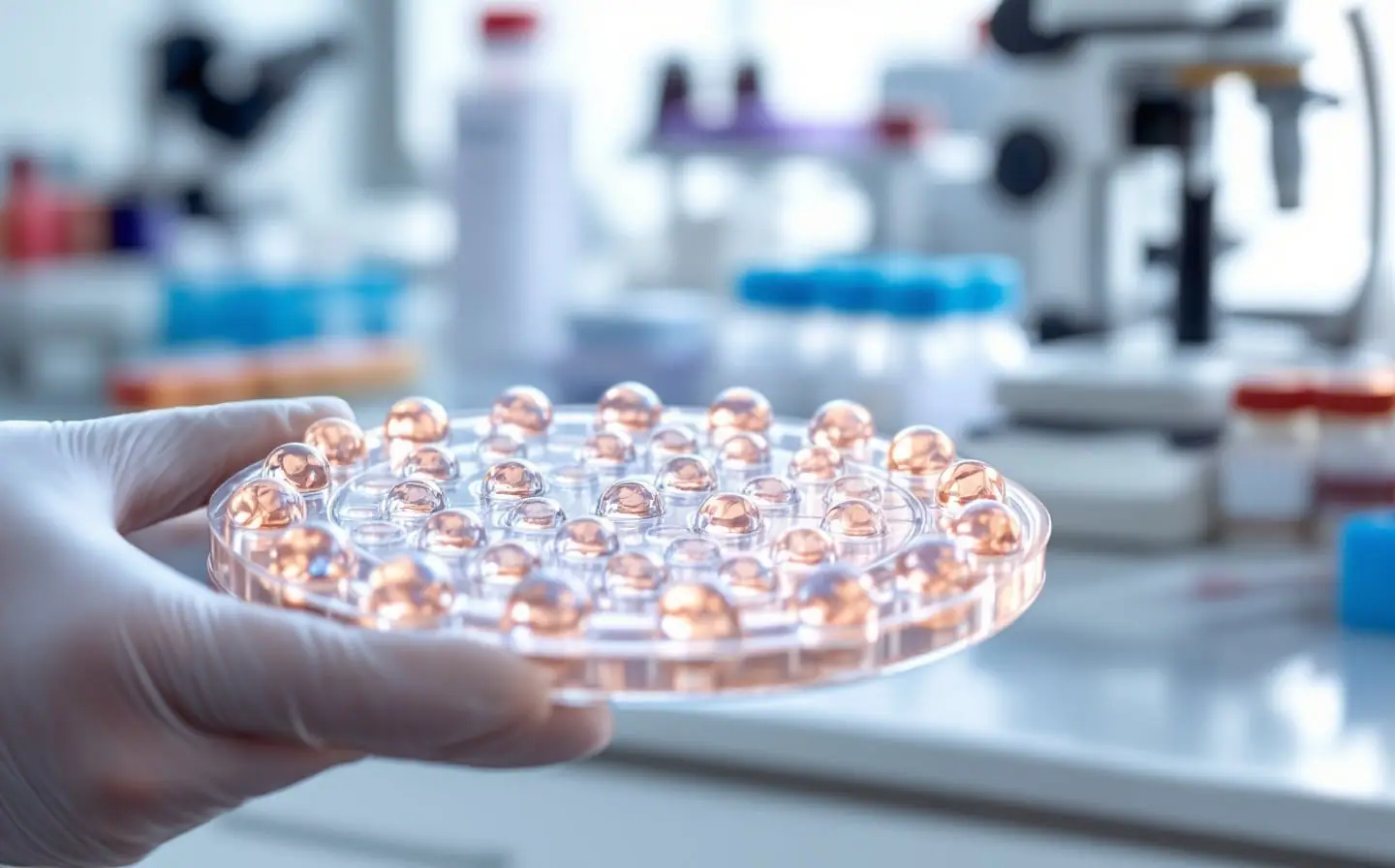
Few lab techniques have spread as fast in the past 15 years as organoids. They turn up in cancer research, infectious disease, drug safety testing and, since 2025, in federal plans to cut animal testing. They also come with a nickname, "mini-organs," that oversells them. Here are the questions people ask most.
The basics
What is an organoid?
A small three-dimensional cluster of cells, grown from stem cells, that organizes itself into some of the structures and cell types of a real organ and carries out some of its functions. Gut organoids form folded linings with pockets like the crypts of the intestine. Kidney organoids contain structures resembling early nephrons, the filtering units. Brain organoids form layered zones that resemble parts of the developing cortex.
Most are a few millimeters across or smaller. None is a working organ. They lack blood vessels, nerves and, in most cases, immune cells, and no body sends them hormones or clears their waste.
Where do the starting cells come from?
Two places. Adult stem cells, taken from a small tissue sample such as a gut biopsy, grow organoids of the tissue they came from. Pluripotent stem cells, either embryonic stem cells or induced pluripotent stem cells made from skin or blood, can in principle be guided toward almost any organ, though the guiding takes longer and is harder to control. Our explainer on what makes a stem cell a stem cell covers the difference.
How new is this?
The modern field is usually dated to 2009, when Toshiro Sato, Hans Clevers and colleagues at the Hubrecht Institute in the Netherlands reported in Nature that a single intestinal stem cell, marked by a gene called Lgr5, could grow into a structure with crypts and villi. Madeline Lancaster and Jürgen Knoblich in Vienna described brain organoids in 2013, and kidney organoids built from iPSCs followed in 2015 from Melissa Little's lab in Melbourne.
Growing them
What do organoids grow in?
Usually a gel. The most widely used is Matrigel, a protein mixture extracted from a mouse tumor. It is rich in laminin and collagen IV, the proteins of the thin basement membrane that linings such as the gut wall sit on, and it gives cells a soft scaffold to grow into in three dimensions instead of flat on plastic.
Its drawbacks are well known: it varies from batch to batch, carries mouse proteins nobody fully controls, and comes from animals, which matters to anyone building non-animal test methods. Many groups are developing synthetic hydrogels with defined ingredients as replacements.
What tells the cells what to become?
Signaling molecules added to the culture medium, chosen to mimic what a developing embryo or a healthy tissue would provide. A typical gut organoid medium contains R-spondin (which boosts the Wnt signal that keeps intestinal stem cells dividing), EGF (a growth factor) and Noggin (which blocks a competing signal called BMP). For pluripotent cells, the recipe changes in stages over weeks or months, walking the cells through the same decisions an embryo makes.
What does the process look like?
A simplified version for intestinal organoids from a biopsy:
- A small piece of tissue is taken during an endoscopy.
- The lab digests it and isolates the crypts, which hold the stem cells.
- The crypts are mixed into gel and set as small domes in culture plates.
- Medium with growth factors goes on top.
- Within days, the crypts round up and start to sprout buds.
- Roughly once a week the organoids are broken into fragments and replated, which multiplies them. Lines can be frozen and stored in biobanks.
Brain organoids from pluripotent cells take far longer. They are often kept for months, sometimes more than a year, usually in spinning flasks or on shakers so nutrients reach more of the tissue.
What they are used for
Gut organoids
The best-known clinical example comes from cystic fibrosis. Organoids grown from a rectal biopsy swell when the CFTR channel, the protein that is faulty in the disease, works and is switched on with a compound called forskolin. Researchers in the Netherlands used this swelling test to see whether an individual patient's cells respond to CFTR modulator drugs, which helps most for people with rare mutations never studied in large trials.
Gut organoids also solved an old lab problem. Human norovirus, the classic cruise ship stomach bug, would not grow reliably in standard cell lines. In 2016, a team at Baylor College of Medicine reported in Science that it grows in human intestinal organoids, giving researchers a way to test disinfectants and antivirals against it.
Brain organoids
In 2016, several groups used brain organoids to show that Zika virus infects and kills neural progenitor cells, the cells that build the cortex, which helped explain the microcephaly seen in some babies infected before birth. They are also used to study autism, epilepsy and the slow timing of human brain development. In 2022, Sergiu Pasca's group at Stanford reported in Nature that human brain organoids transplanted into newborn rats grew, wired into the rats' circuits and responded to whisker stimulation.
Kidney organoids
These are used to model inherited disorders such as polycystic kidney disease, in which they form cysts in the dish, and to look for kidney damage caused by drug candidates. They cannot filter blood, because filtering needs blood flow.
Tumor organoids
Organoids grown from a patient's tumor often keep the genetic features of the original. Collections of them, sometimes called living biobanks, let researchers test many drugs on many tumors at once. Several small studies, including a 2018 report in Science on gastrointestinal cancers, found that organoid responses lined up well with how patients' tumors responded. Organoid-guided treatment choice is still being tested in clinical trials; it is not routine care.
Drug safety
Liver organoids and organ chips (small devices in which cells line channels with fluid flowing past) are used to flag drugs that might damage the liver before they reach people. For how findings like these move toward the clinic, see our explainer on translational medicine.
Where they fall short
| Organoids can show | Organoids usually cannot show |
|---|---|
| How a mutation changes a cell type's behavior | How the body absorbs, spreads and clears a drug |
| Whether a virus infects a given human cell | How the immune system joins the response |
| How one tumor's cells respond to a drug in a dish | Effects that depend on blood flow, nerves or hormones |
| Early steps of human organ development | Adult diseases that take decades to unfold |
Why don't they have blood vessels?
Organoids are fed by diffusion from the medium around them. Past a certain size, oxygen and nutrients cannot reach the center and the core dies, which caps how large and complex they can get. Labs work around this by slicing organoids, adding blood vessel cells, building them into chips with flowing channels, or transplanting them into animals, where host vessels grow in.
Why do results vary so much?
Two organoids from the same line and the same week can differ in size, shape and cell types, and brain organoids vary most of all. The gel, the donor line and each lab's protocol all add noise. Guided protocols, more organoids per experiment and single-cell sequencing to check what actually grew have helped, but variability is still the most common criticism in peer review.
Are they adult or fetal?
Mostly fetal, especially those made from pluripotent cells. A brain organoid several months old looks more like a mid-pregnancy cortex than an adult brain, which suits studies of development better than studies of diseases of aging.
Rules and ethics
Did a law change to let organoids replace animal tests?
In part. The FDA Modernization Act 2.0, signed in December 2022 as part of a larger federal spending law, removed the old statutory wording that required animal tests before a new drug could be tried in people. It spelled out that nonclinical tests can include cell-based assays, organ chips, computer models and other human biology-based methods. It did not ban animal testing. A developer still has to convince the FDA that its data justify a human trial.
What did the FDA announce in 2025?
On April 10, 2025, the FDA announced a plan to phase out its animal testing requirement, starting with monoclonal antibodies, and published a roadmap. It said it would encourage developers to include data from new approach methodologies, such as computer models of toxicity and organoid testing, in applications to begin human trials. Later that month, the NIH said it would prioritize human-based research methods and set up a new office to coordinate the shift.
The change is gradual. For most new drugs, animal studies remain part of the safety package for now, and any organoid method has to be shown to predict human outcomes for the question at hand.
Could a brain organoid think or feel?
Not as far as anyone can tell. Brain organoids have no sensory input, no blood supply, a few million cells at most (an adult brain has roughly 86 billion neurons) and only crude circuitry. In 2021, a National Academies of Sciences, Engineering, and Medicine committee examined the question and concluded that current neural organoids are far too limited to raise realistic concerns about awareness or pain, while recommending that oversight keep pace as the models grow more complex. The ISSCR's research guidelines call for informed consent from cell donors and specialist review of experiments that transplant human brain cells into animals.
Who decides what happens to an organoid made from my cells?
Mostly the consent form. Biobanks generally ask donors whether their cells may be shared, used by companies, sequenced or turned into other tissue types. Some ethicists argue donors should be asked separately about brain organoids and animal transplants, because people feel differently about those uses than about a gut culture.
How do I tell a careful organoid study from a weak one?
Look for four things in the paper or press release:
- How many donors. Results from one person's cells may reflect that person, not the disease.
- How many batches. An effect seen in one batch and never repeated is a warning sign.
- A check against real tissue or patient data. The strongest papers show that organoid findings match what happens in people.
- What is missing. If the question involves immunity, blood flow or how the liver breaks down a drug, ask how an organoid without those things could answer it.
This explainer is general information, not medical advice. Decisions about treatment, donation or trials belong with a clinician who knows your history.