A day in a cell therapy manufacturing lab, hour by hour
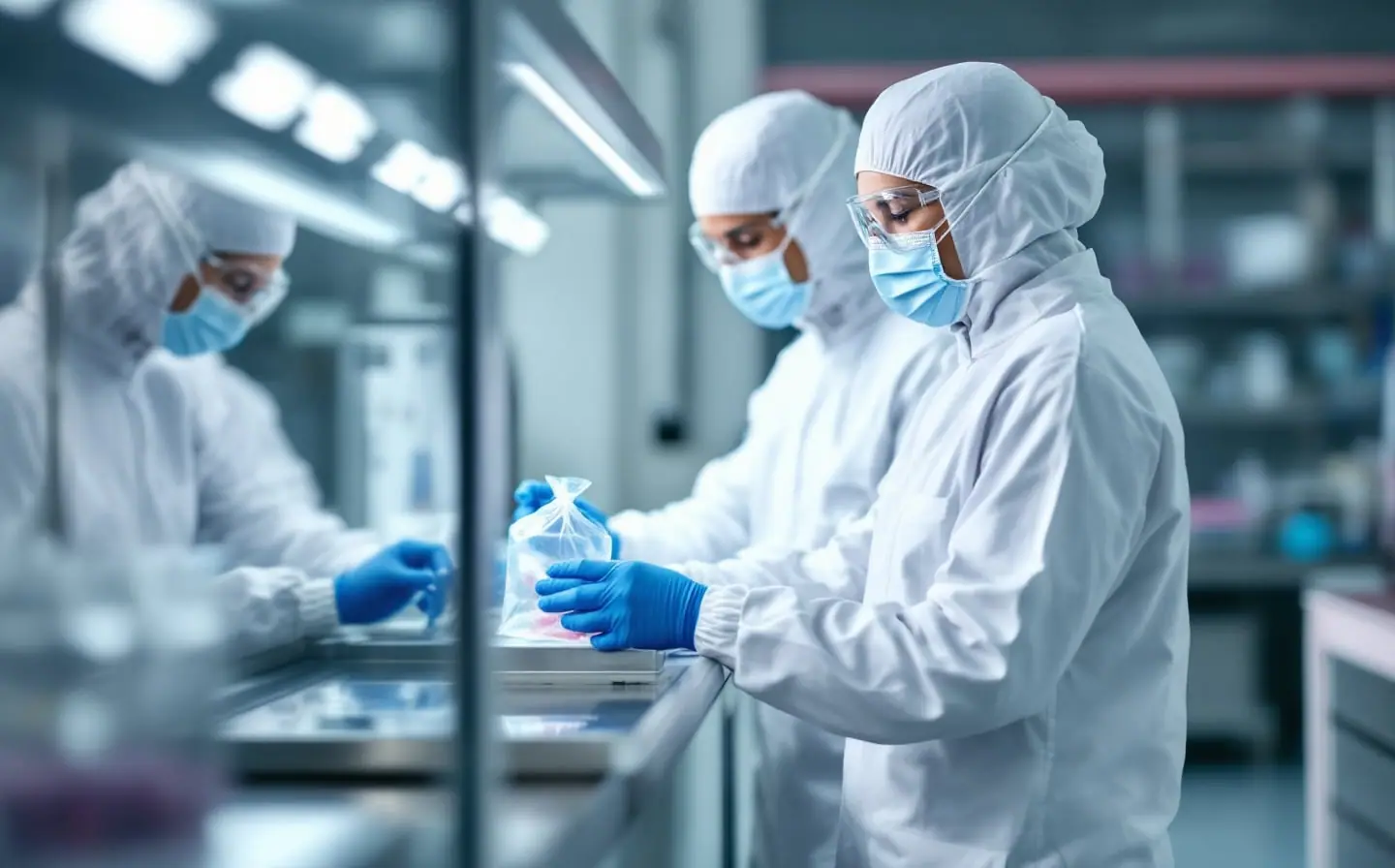
Outsiders tend to picture a cell therapy cleanroom as a quiet room full of gleaming machines. The machines are there, but most of the day is shaped by rules about air, gloves, clocks and paperwork.
What follows is a composite day. It is not one real person's diary. It stitches together the routine that staff in GMP (good manufacturing practice) cell therapy facilities commonly describe, using a site that makes personalized CAR-T products as the example. Details vary between companies, hospital facilities and contract manufacturers, so read the times as typical, not exact. For the bigger picture of what is being made, our explainer on how a cell therapy is made, from donor to dose walks through the whole chain.
The composite shift
5:45 a.m. Locker room
Our composite technician, a day-shift lead, badges in and swaps street clothes for facility scrubs and dedicated shoes. Watches and rings go in the locker. Makeup, nail polish and artificial nails are off-limits in most cleanrooms because they shed particles.
6:00 a.m. Handover
Night shift briefs day shift. A board lists every patient lot in the building and where each one stands: one starting material arriving from an apheresis center this morning, three lots expanding in bioreactors, one due for harvest this afternoon. The outgoing lead mentions an incubator that alarmed overnight and recovered within limits. Handover is short, but it prevents a lot of mistakes, so nobody rushes it.
6:30 a.m. Paperwork before cells
Before anyone touches product, the team reviews the batch record for each step planned today. A batch record is both the step-by-step instruction set and the legal record of what happened to that lot. Reagent lot numbers, expiry dates and labels are checked against it, and a line clearance confirms the room holds nothing from a previous lot. Two patients' cells never share a workspace at the same time.
6:45 a.m. Gowning
Gowning follows a fixed order, moving from less clean to cleaner zones: hand wash, hair cover, beard cover if needed, face mask, then a sterile coverall put on without letting it touch the floor, a sterile hood, goggles, boot covers and two pairs of sterile gloves. Gloves are sprayed with sterile alcohol. A mirror check at the end catches a stray strand of hair or a gap at the wrist.
Everyone entering the aseptic area has passed a gowning qualification, which usually means gowning under observation and having the gown sampled for microbes. The routine takes 10 to 20 minutes and is repeated on every re-entry.
7:15 a.m. A new lot arrives
The starting material, a bag of the patient's white blood cells collected by apheresis, is received and inspected. The most important checks are about identity: every label, form and system entry must match, and a second person verifies it. In autologous therapies, where each dose is made from the patient's own cells, a mix-up is the worst possible failure, so the chain of identity is confirmed at every handoff.
8:00 a.m. Aseptic work at the cabinet
Open manipulations happen inside a biosafety cabinet, the Grade A zone, which sits in a Grade B room. Modern processes keep as much as possible inside closed bags and tubing, but there is still hands-on work: sampling, adding reagents, setting up activation and, later, adding the viral vector that carries the CAR gene.
Movements are slow and deliberate. Nothing may block the "first air" reaching an open container, and every item entering the cabinet is wiped with disinfectant first. Each step is signed in the batch record as it happens, and a second operator checks the critical ones.
9:30 a.m. Environmental monitoring
Meanwhile, a particle counter samples the air in the cabinet continuously. Settle plates, open dishes of growth medium, sit in fixed spots to catch anything drifting down. When a session ends, operators press their gloved fingertips onto contact plates, and surfaces are sampled the same way. The plates go to the quality control microbiology lab and incubate for several days. A count above an action limit starts an investigation, sometimes long after the session itself.
10:30 a.m. Break, and the regown
A break means degowning, leaving and gowning again on return, so breaks are planned around process steps rather than hunger. It is a common complaint, and a fair one.
11:30 a.m. Feeding and sampling
Expanding lots need fresh medium and in-process samples, which go to QC for cell counts, viability and, at set points, safety tests such as sterility, mycoplasma and endotoxin. A CAR-T product commonly spends somewhere around one to two weeks in manufacturing, with release testing on top, so the team is always juggling lots at different stages.
1:15 p.m. Something goes slightly wrong
An operator realizes a step was done eight minutes outside the time window the batch record allows. The cells look fine. That does not matter. The rule is to stop, tell the supervisor and record a deviation. Quality assurance decides whether it could affect the product, looks for a root cause and, if needed, opens a corrective and preventive action (CAPA), perhaps a timer alarm or a clearer instruction.
What nobody does is quietly tidy the record. Errors get a single line through them, with initials, date and a reason, so the original stays readable.
2:30 p.m. Harvest
The finished lot is washed, concentrated, counted, formulated in a freezing medium and filled into labeled infusion bags, which go through a controlled-rate freezer into liquid nitrogen storage. QC completes release testing and QA reviews the full record before the product ships to the hospital. The team almost never meets the patient, but everybody knows there is one.
4:00 p.m. Cleaning and record review
Cabinets, carts, floors and walls are wiped in a set pattern, with a disinfectant and a sporicidal agent used in rotation. Then, outside the clean area, the team checks the day's records for missing signatures and calculation slips before QA does. A record that is "right first time" is a point of pride.
6:00 p.m. Handover
Day shift briefs night shift, and the cycle continues. Cells do not keep office hours.
Cleanroom grades in plain terms
Europe's GMP rules for sterile products, known as Annex 1 (revised in a version that took effect in August 2023), define four cleanroom grades. US facilities more often use ISO 14644-1 classes and the FDA's aseptic processing guidance, but the ideas map closely.
| Grade | Typical use in a cell therapy facility | Rough ISO equivalent |
|---|---|---|
| A | Inside the biosafety cabinet or isolator, where product is open to the air | ISO 5 |
| B | The room around a Grade A cabinet used for open processing | ISO 5 at rest, ISO 7 in operation |
| C | Less critical steps, staging and some closed processing | ISO 7 at rest, ISO 8 in operation |
| D | Support areas, material preparation, some corridors | ISO 8 at rest |
The cleaner the grade, the stricter the gowning, the tighter the particle limits and the more often the room is monitored.
Shift patterns
Lots cannot pause, and the patient's collection date drives the schedule, so many facilities run seven days a week. Common patterns include 12-hour rotating shifts (often a two-two-three rotation that gives every other weekend off), four 10-hour days, or fixed nights with a pay differential. Some people love three or four days off in a row; others find the early starts wear them down.
Who works there
- Manufacturing associates or technicians do the hands-on production, with titles often running from level I to III.
- Quality control analysts run in-process and release tests, and microbiology analysts read the monitoring plates.
- Quality assurance specialists review records, deviations and changes, often from a desk on the production floor.
- Manufacturing science and technology (MSAT) staff own the process itself: troubleshooting, technology transfer and improvements.
- Supervisors and managers plan the schedule and lead investigations.
How people got in
Routes in are more varied than students assume. A bachelor's degree in biology, biotechnology, biochemistry or a related subject is the most common path to a manufacturing associate role, but it is not the only one. Associate degrees and short certificates feed entry-level process technician jobs. North Carolina's community colleges, for example, run a BioWork certificate covering GMP basics, aseptic processing and cell growth. People also cross over from hospital labs, blood banks, academic research, food plants and the military.
Few entry-level hires bring real GMP aseptic experience, and employers expect to teach it. They screen instead for people who follow instructions exactly and document honestly. Our overview of careers in the life sciences compares manufacturing with research, clinical and business roles, and our page on stem cell technology covers isolation, expansion and cryopreservation in more depth.
Skills that transfer
The habits built in a GMP suite travel well:
- Good documentation practice. Recording what you did, when you did it, legibly and at the time, is valued in clinical research, regulatory affairs and every quality role.
- Aseptic technique, for sterile drug manufacturing, tissue banks and other cell processing labs.
- Deviation and root cause work. Investigating a problem without hunting for someone to blame is a core skill in any regulated industry.
- Working to a schedule you do not control, and talking daily with QC, QA, supply chain and engineering.
Many use a few years in manufacturing as a step into QA, MSAT, validation or project management, and some move further, a path we cover in moving from the bench to the business side of biotech.
What people like and dislike
| Often liked | Often disliked |
|---|---|
| Knowing each lot is for one specific patient | Gowning and degowning for every break |
| Clear procedures and visible standards | Repetition once the process is mastered |
| Long blocks of days off on 12-hour rotations | Early starts, nights and weekend work |
| Tight teamwork and clean handoffs | The documentation load and fear of errors |
| A quick route into quality and process roles | Standing for hours in a full gown |
| Hands-on biology most graduates never touch | Investigations that land weeks after the work |
One question worth asking at interview
The texture of the job depends on whether a facility runs mostly closed, automated systems or open manual processing. Closed systems mean more time with instruments and software; open processing means more aseptic handwork, monitoring and gowning. Asking which one you would be doing, and how many lots a team runs in a typical week, will tell you more about your future days than the job title will.
This explainer is general information, not medical advice. Decisions about treatment, donation or trials belong with a clinician who knows your history.