Science & Society · Life Sciences Careers
Microscope for Kids: How to Choose One They Will Actually Use

Product links may earn us a commission. As an Amazon Associate I earn from qualifying purchases.
The right microscope for a child matches what they want to look at, and the number on the box is a poor guide to that. Most children under 8 get the most from a handheld pocket microscope that shows leaves, bugs and coins with no slides. From about 8 to 12, a kit microscope with one light above the stage and one below handles both solid objects and simple slides. Teenagers who want to see cells are ready for a proper compound microscope with glass optics, a metal frame and a fine focus knob.
At every age, a few things decide whether it gets used or ends up in a closet: glass lenses where they matter, a bright LED, smooth focusing and honest magnification. School biology does most of its work at 400x. A box promising 1200x is selling a number, not a sharper picture.
Bench shortlist
| Item | Use | Note |
|---|---|---|
| Pocket LED microscope, 60x to 120x (Carson MicroBrite Plus)$14.99 Amazon listing, Oct 22, 2026, 12:33 PM ETOpen on Amazon | A pocket-size zoom microscope with its own light, for leaves, insects and fabric away from a table. | 60x to 120x zoom · built-in LED · pocket size |
| Dual LED microscope kit for children$89.99 Amazon listing, Oct 22, 2026, 12:33 PM ETOpen on Amazon | A sturdy starter microscope with lights above and below, so children can look at both slides and solid objects. | ages 8 to 12 · top and bottom LED |
| All-metal student compound microscope, 40x to 1000x (AmScope M150C)$114.99 Amazon listing, Oct 22, 2026, 12:33 PM ETOpen on Amazon | A sturdier step up for teenagers: glass optics, a metal frame and a cordless LED for slides. | 40x to 1000x · metal frame · LED, mains or 3 AA batteries |


Picked from specifications, manuals and published reviews, not tested by us. Product prices and availability are accurate as of the date/time indicated and are subject to change.
What matters at each age
Under 8: something they can hold
Young children want to point the thing at the world. A pocket microscope pressed against a leaf, a sleeve or a beetle's back gives them that, with no slide to prepare. The Quekett Microscopical Club, a British microscopy society founded in 1865, suggests a simple handheld "mini" microscope as a good way to find out whether a child under 10 is interested before buying anything more advanced. At this age an adult should handle any glass slides.
8 to 12: a light above and a light below
Light from above shows the surface of solid things such as coins, seeds and insect wings. Light from below shines up through a thin sample on a slide, which is how you see cells. A desk microscope with both stays useful after the slide box runs out. With an adult nearby, children this age can make simple wet mounts and learn the core rule: find the sample at the lowest power first.
Teenagers: a compound microscope like the school one
A teenager doing school biology or home schooling needs a compound microscope that works like a classroom one: glass objectives (usually 4x, 10x and 40x), a metal frame that holds focus, a fine focus knob and a light under the stage that can be dimmed or narrowed. A teen who gets serious may move on to counting cells on a hemocytometer, a thick slide ruled with a grid; our hemocytometer calculator turns that count into cells per milliliter.
Bench essentials
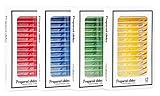
- Prepared slide set, 48 specimens$13.79 Amazon listing, Oct 22, 2026, 12:33 PM ETOpen on Amazon
- Blank slides with cover slips$17.99 Amazon listing, Oct 22, 2026, 12:33 PM ETOpen on Amazon

Chosen from specifications and published reviews. As an Amazon Associate I earn from qualifying purchases. Product prices and availability are accurate as of the date/time indicated and are subject to change. All bench picks
Pocket, stereo or compound
| Type | Magnification | Shows | Slides needed? |
|---|---|---|---|
| Pocket or handheld zoom | a zoom range, for example 60x to 120x | surfaces: leaves, fabric, coins, insects | no |
| Stereo ("dissecting") | about 10x to 40x on school models | whole solid objects in 3D | no |
| Compound | about 40x to 1000x | thin, see-through samples: cells, pond life | yes |
A stereo microscope has two eyepieces and two separate light paths, angled about 10 to 12 degrees apart according to Nikon's MicroscopyU education site, so the brain gets a true 3D view. There is room under the lens for a snail shell or a flower. The buying guide from Carolina Biological Supply, a school science supplier, puts stereo models at 10x to 40x and compound models at 40x to 1000x. One catch: younger children can struggle to look through both eyepieces at once, a point the Quekett Club raises for children under 10.
A compound microscope stacks two lenses, the objective near the sample and the eyepiece near the eye, and sends light up through the specimen. So the sample must be thin, and the image appears upside down and moves the opposite way to the slide. Our labeled guide to microscope parts and how to use a compound microscope names every knob and lens.
Why the big number on the box misleads
Total magnification is the eyepiece power times the objective power, so a 10x eyepiece over a 40x objective gives 400x. That number says how big the image is, not how much detail it holds. Detail depends on the objective's numerical aperture, a measure of how much light it gathers. MicroscopyU gives the standard rule: useful magnification runs from about 500 to 1000 times the numerical aperture. A common student 40x objective is marked 0.65, so it stops adding detail at roughly 650x. Beyond that you get empty magnification, a larger, softer picture with nothing new in it.
So 400x is the working top end for school biology. The Quekett Club describes compound microscopes as most useful from 40x to 400x, and a Nova Scotia Museum leaflet for parents says 300x to 500x is fine for most student work. At 400x you can see nuclei in onion skin, chloroplasts in pondweed and single-celled organisms swimming in pond water.
Real 1000x work in research and hospital labs uses a 100x objective with a drop of immersion oil between lens and slide. Oil lets the lens gather more light than a dry lens can: MicroscopyU notes that numerical apertures above 0.95 are hard to reach with dry objectives, while most oil objectives top out around 1.4. A kit that reaches 1200x through a stronger eyepiece on a dry lens shows no more detail than its 40x objective can deliver, only bigger and dimmer. Treat anything above 400x as a bonus, never the reason to choose a model.
Light, focus and a first session
LEDs are now the norm on student microscopes: they run cool, which is kinder to living samples, and use little power, so cordless models rely on them. Bottom light is for slides, top light for anything opaque. A sample too thick to let light through looks black under a compound microscope.
Look for light control under the stage. Simple microscopes use a disc with holes of different sizes; better ones have an iris diaphragm that opens and closes like a camera's. Closing it a little adds contrast to unstained cells.
For focus, the Nova Scotia Museum leaflet says the rack and pinion gear that moves the tube or stage should run smoothly without slipping. On a compound microscope, a separate fine focus knob is close to essential at 400x, where the sharp zone is very thin.
How to use a microscope with a child the first time:
- Set it on a steady table, back from the edge, with the light on medium.
- Choose the lowest power and an easy sample, such as a prepared slide or a leaf.
- Bring the lens close to the sample while watching from the side.
- Look in, then focus by moving the lens away from the sample until the image appears.
- Center the part you want, step up one power and refocus with the fine knob.
Keep early sessions to 10 or 15 minutes and let the child drive.
Glass or plastic optics
Glass lenses hold their shape, resist scratches and usually give a crisper image than molded plastic, which is why the Nova Scotia Museum leaflet advises glass, with objectives in sturdy metal mounts. On a compound microscope this is the specification that matters most. If a listing does not say "glass optics" or "glass lenses", assume plastic.
Plastic still has a place. The Quekett Club points out that plastic mini microscopes are very resistant to damage, exactly what a five-year-old needs. A metal frame matters more as the child grows: the weight keeps it from tipping, and a metal focus mechanism stays where you set it.
What should come in the box
- Prepared slides: ready-made, stained specimens, thin and easy to focus on.
- Blank slides and cover slips for your own wet mounts of pond water, onion skin or a hair. The Nova Scotia Museum leaflet warns that kits rarely include enough.
- A dropper, tweezers and a small dish.
- Stains such as iodine or methylene blue, for use with an adult. Iodine stains skin and clothes.
Skip kits padded with plastic gadgets. Feathers, butterfly wings and bee legs are easy to collect yourself. Cover slips are very thin glass, so show children how to hold them by the edges.
The first five things to look at
- A leaf, top and underside. Under a pocket or stereo microscope the veins and fine hairs show up at once.
- Salt and sugar. Table salt forms neat little cubes; sugar crystals look different.
- A hair beside a cotton thread and a synthetic one. Compare the surfaces.
- A letter "e" cut from a newspaper, on a slide under a compound microscope. It appears upside down and backwards, and when you push the slide left the "e" moves right.
- A drop of pond water from near the plants, under a cover slip, at the lowest power first. Something moving is often the moment a child gets hooked.
Once children have seen cells, the next question is usually where new cells come from. Our piece on talking about stem cells in the classroom has ways to answer it at different ages.
Common mistakes
- Buying for the biggest number. A 1200x claim on a toy is a warning sign.
- Starting at high power. The child sees a blur and gives up.
- Too much light. A washed-out field hides unstained cells; dim it or close the diaphragm.
- Thick samples under a compound microscope. Slice them thinner or switch to top light.
- Coarse focus at 400x. This is how slides crack.
- Packing it away after every use. A microscope left out on a shelf with a few slides tends to get used.
How the picks below line up with the ages
The products below were chosen from specifications, manuals and published reviews: one for each stage of the age guide, plus slides.
For the youngest children, start with a pocket zoom microscope. It zooms from 60x to 120x, has a built-in LED, runs on batteries and needs no slides: press it against a leaf, a coin, a sleeve or a dead fly.
For ages 8 to 12, the dual LED kit microscope is made for roughly that range and has lights above and below, so it handles solid objects and slides alike.
For teenagers and home schooling, an all-metal compound microscope with glass optics is the step up. It is monocular, with settings of 40x, 100x, 250x, 400x and 1000x, and the head rotates 360 degrees, so a parent and child can swing it across the table. A single-lens condenser with a disc diaphragm controls the light, and the LED runs from an adapter or 3 AA batteries. Following the rule above, plan on doing most work at 400x and below.
Whichever microscope you choose, add slides. A box of 48 prepared slides of plants, animals and insects gives a child something sharp to focus on at once, and 50 blank slides with 100 cover slips cover everything they want to mount themselves.
Bench essentials
- Pocket LED microscope, 60x to 120x (Carson MicroBrite Plus)60x to 120x zoom · built-in LED · pocket sizeA pocket-size zoom microscope with its own light, for leaves, insects and fabric away from a table.$14.99 Amazon listing, Oct 22, 2026, 12:33 PM ETOpen on Amazon
- Dual LED microscope kit for childrenages 8 to 12 · top and bottom LEDA sturdy starter microscope with lights above and below, so children can look at both slides and solid objects.$89.99 Amazon listing, Oct 22, 2026, 12:33 PM ETOpen on Amazon
- All-metal student compound microscope, 40x to 1000x (AmScope M150C)40x to 1000x · metal frame · LED, mains or 3 AA batteriesA sturdier step up for teenagers: glass optics, a metal frame and a cordless LED for slides.$114.99 Amazon listing, Oct 22, 2026, 12:33 PM ETOpen on Amazon
- Prepared slide set, 48 specimens48 slides · plants, animals, insectsReady-made slides of plant, animal and insect tissue for practising focus and identification.$13.79 Amazon listing, Oct 22, 2026, 12:33 PM ETOpen on Amazon
- Blank slides with cover slips50 slides · 100 cover slips · ground edgesPre-cleaned glass slides and square cover slips for making your own wet mounts.$17.99 Amazon listing, Oct 22, 2026, 12:33 PM ETOpen on Amazon
Picked from specifications, manuals and published reviews; we have not tested these items ourselves. Product prices and availability are accurate as of the date/time indicated and are subject to change. All our bench picks
FAQ
What age is right for a first microscope?
Preschool and early elementary children can enjoy a handheld pocket microscope with an adult beside them. A two-light desk microscope suits roughly 8 to 12, and a compound microscope with glass optics suits teenagers or any child who wants to see cells.
Is a stereo or a compound microscope better for a child?
For most children under about 10, a stereo or handheld microscope is easier: it shows whole objects in 3D and needs no slides. Choose a compound microscope when the goal is cells and pond life, which need light shining through a thin sample at 100x to 400x.
Does a child need 1000x magnification?
No. Most school biology happens at 400x. Lab work at 1000x uses a 100x oil immersion objective, and the top settings on toy microscopes usually just enlarge a blurry image.
This explainer is general information, not medical advice. Decisions about treatment, donation or trials belong with a clinician who knows your history.