
Lab Safety Rules and Equipment: A Practical Guide for Students
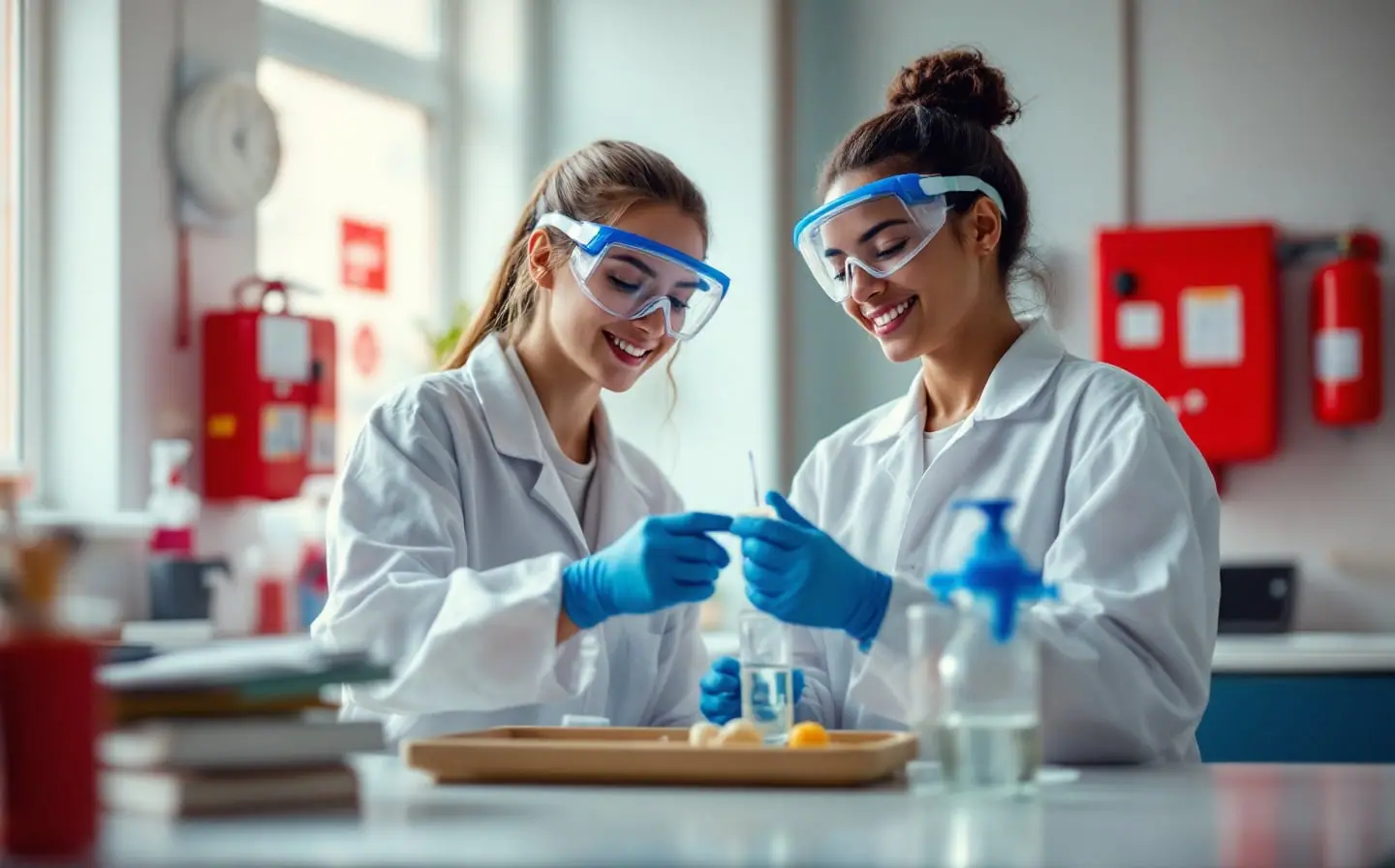
Lab safety rules can look like a list of things you are not allowed to do. Read them again as a list of the ways people actually get hurt in labs (splashes to the eyes, cuts from broken glass, burns, spills on skin, swallowing something by accident, fires) and they make a lot more sense. Each rule below closes off one of those routes.
In US workplaces, the rules come from somewhere specific. The OSHA Laboratory Standard requires employers to have a written chemical hygiene plan, and the OSHA Hazard Communication Standard requires labeled containers and a safety data sheet (SDS) for every hazardous chemical. Both are summarized on the OSHA laboratories page and the hazard communication page. School and university labs build their own rules on the same ideas.
What you need before your first lab
- Chemical splash goggles that fit over glasses if you wear them
- A lab coat that covers your arms and reaches at least to mid-thigh
- Disposable gloves suited to the chemicals in use, usually nitrile
- Closed-toe shoes and clothing that covers your legs
- A hair tie, if your hair is long
- The procedure and the safety data sheets for every chemical on the list, read in advance
The rules, with the reason for each
- Find the exits and the emergency equipment before you start: eyewash, safety shower, fire extinguisher, fire blanket, spill kit, first aid kit, and the way to raise the alarm. In an emergency you will not have time to look.
- Read the procedure and the SDS before the lab, not during it. Surprises are where accidents start.
- Dress for the lab. Closed shoes, legs covered, hair tied back, no loose sleeves or dangling jewelry near flames or moving parts.
- Wear eye protection whenever anyone in the room is working with chemicals, glass or heat, not only when you are. The splash that reaches you may come from the next bench.
- Wear a buttoned lab coat and gloves chosen for the chemical, and keep the coat in the lab.
- No food, drink, gum, cosmetics or putting in contact lenses in the lab, and never keep food in a lab fridge. Hands carry chemicals and microbes to the mouth faster than people think.
- Never pipette by mouth. Use a bulb or a pipette controller.
- Label every container with its contents, concentration, date and your initials. An unlabeled clear liquid has to be treated as dangerous.
- Add acid to water, never water to acid. Water poured into concentrated acid can boil locally and spatter acid out of the container.
- Use a fume hood for volatile, toxic or strong-smelling chemicals. Keep the sash as low as practical and work at least 6 inches inside it.
- Never taste anything, never sniff directly from a container (waft toward your nose if you must), and never pour unused chemical back into the stock bottle.
- Keep the bench clear and bags off the floor around benches and walkways.
- Put waste in the right container: broken glass box, sharps container, chemical waste, biohazard waste. Never put broken glass in the trash.
- Take gloves off before touching door handles, phones or keyboards, and wash your hands before you leave.
- Report every accident, spill or near miss, however small, and don't work alone with hazardous materials.
Lab safety equipment and what it does
| Equipment | Protects against | Use it when | Quick check |
|---|---|---|---|
| Safety glasses with side shields | flying particles, small splashes from the side | dry work, glassware, low-splash tasks | marked Z87, no cracks |
| Chemical splash goggles | liquid splashes and droplets | pouring, mixing, any corrosive liquid | indirect vents, seal around the eyes, marked D3 |
| Face shield | large splashes to the whole face | big volumes of corrosives, pressure or cryogenic work, always over goggles | clean and unscratched |
| Lab coat | splashes on skin and clothes | all lab work | right size, buttoned |
| Gloves | skin contact | chemicals and biological material | right material, no tears |
| Fume hood | breathing in vapors | volatile or toxic chemicals | airflow indicator working, sash at the marked height |
| Eyewash station | chemicals in the eyes | straight after an eye splash | clear path, flushed weekly |
| Safety shower | large splashes on the body | major spills on skin or clothing | nothing stored under it |
| Fire extinguisher and blanket | small fires | only if trained and it is safe | inspection tag current |
| Spill kit | a spill spreading | acids, bases, solvents | stocked for the chemicals in use |
| Biosafety cabinet | aerosols from cultures | microbiology and cell culture | certified, airflow alarm on |
The eyewash and shower rules come from the ANSI Z358.1 standard, which calls for units that can be reached within about 10 seconds, deliver a flushing flow for 15 minutes, and are activated weekly so the water stays clean. If chemicals get in your eyes, hold the eyelids open under the flow for the full 15 minutes and get medical help. For culture work, the biosafety cabinet and the habits around it are covered in our guide to aseptic technique.
Lab safety goggles, glasses or a face shield?
The marking on the frame tells you what eyewear has been tested for under the ANSI/ISEA Z87.1 standard. "Z87" means it meets the basic impact test, "Z87+" the high-impact test. "D3" means it protects against splashes and droplets, which is the marking that matters for most chemistry and biology work with liquids.
- Safety glasses stop flying particles but leave gaps around the eyes. Liquid can run in from above or below.
- Indirect-vent splash goggles seal around the eyes, and their covered vents let air through without letting liquid in. This is the default for working with liquids.
- Direct-vent goggles have open holes. They are meant for impact and dust, not chemical splashes.
- A face shield is extra protection worn over goggles, never instead of them.
Everyday prescription glasses are not safety eyewear unless they carry the Z87 mark; wear goggles designed to fit over them. Contact lenses are not eye protection, and labs differ on whether they may be worn under goggles, so ask.
Common mistakes, and what is actually true
| What people assume | What is actually true |
|---|---|
| "My glasses count as eye protection." | Ordinary glasses are not tested for impact or splash. Wear goggles over them. |
| "Gloves protect against everything." | Each glove material resists different chemicals. Nitrile suits many water-based solutions and dilute acids but gives poor protection against some solvents, such as acetone and chloroform. Check the manufacturer's chemical resistance chart. |
| "I finished, so the goggles can come off." | Others may still be pouring. Keep them on until the whole room has finished. |
| "A small spill isn't worth reporting." | Small spills are how the next person gets hurt. Report it and use the spill kit. |
| "Water puts out any fire." | Not burning solvents, metals or electrical fires. Raise the alarm, and use an extinguisher only if you are trained. |
| "A polyester coat is fine." | Synthetic fabrics can melt onto skin. Cotton or poly-cotton suits general work; flame-resistant coats are used with flammable chemicals. |
Worked example: a pre-lab safety check
Say the practical asks you to make 100 mL of 1 M hydrochloric acid from a 2 M stock. Here is what a safety check looks like before you touch a bottle.
Read the SDS. Every SDS under the OSHA standard has the same 16 sections in the same order, so you learn where to look once:
| Section | What you take from it |
|---|---|
| 2, Hazard identification | the hazard class, pictograms and warnings; hydrochloric acid irritates or burns skin and eyes depending on strength |
| 4, First aid | what to do for eye, skin, inhalation and swallowing exposures |
| 6, Accidental release | how to contain and neutralize a spill |
| 7, Handling and storage | what to keep it away from, such as bases and some metals |
| 8, Exposure controls | the protective equipment it calls for |
| 13, Disposal | how waste must be handled |
Do the arithmetic. With C1V1 = C2V2, you need 50 mL of the 2 M stock made up to 100 mL, which the dilution calculator confirms in seconds.
Then plan the steps. Splash goggles, gloves and coat on. Put about 40 mL of water in a 100 mL graduated cylinder or volumetric flask first, add the 50 mL of acid to the water, never the other way round, then make up to the 100 mL mark with water and mix. Concentrated hydrochloric acid gives off fumes and belongs in a fume hood; a 2 M solution is less volatile, but follow your instructor's rule. Know where the spill kit and eyewash are before you start, and label the finished bottle "1 M HCl", with the date, your initials and the hazard. Write all of this in your notebook as you go, following our guide to keeping a lab notebook.
FAQ
What are the most important lab safety rules?
Wear eye protection whenever anyone is working, know where the eyewash and exits are, never eat or drink in the lab, label everything, and report every accident. Each one closes off a common route to injury.
What safety equipment should every lab have?
Eye protection, lab coats and gloves for each person, plus an eyewash station, safety shower, fire extinguisher, spill kit, first aid kit and marked exits. Labs using volatile chemicals need fume hoods; labs working with cultures need biosafety cabinets.
Are safety glasses enough for chemistry?
For dry work and low-splash tasks, sometimes. For pouring or mixing liquids, especially corrosives, use indirect-vent splash goggles marked D3.
How do I take off contaminated gloves?
Pinch the outside of one glove at the wrist and peel it off inside out, hold it in the gloved hand, then slide a bare finger under the cuff of the second glove and peel it over the first. Drop both in the right waste and wash your hands.
This explainer is general information, not medical advice. Decisions about treatment, donation or trials belong with a clinician who knows your history.